You're Adding Weight Wrong
Three mistakes that kill progression—and the simple fix that actually works.

Most people fail at strength training not because they don’t work hard enough.
They fail because they fundamentally misunderstand how progression works.
They start too heavy. They add weight randomly. They chase new programs every month. Then they wonder why they’re stuck at the same numbers a year later.
Here’s the truth: progression isn’t complicated, but most people get it backwards.
The Three Fatal Mistakes
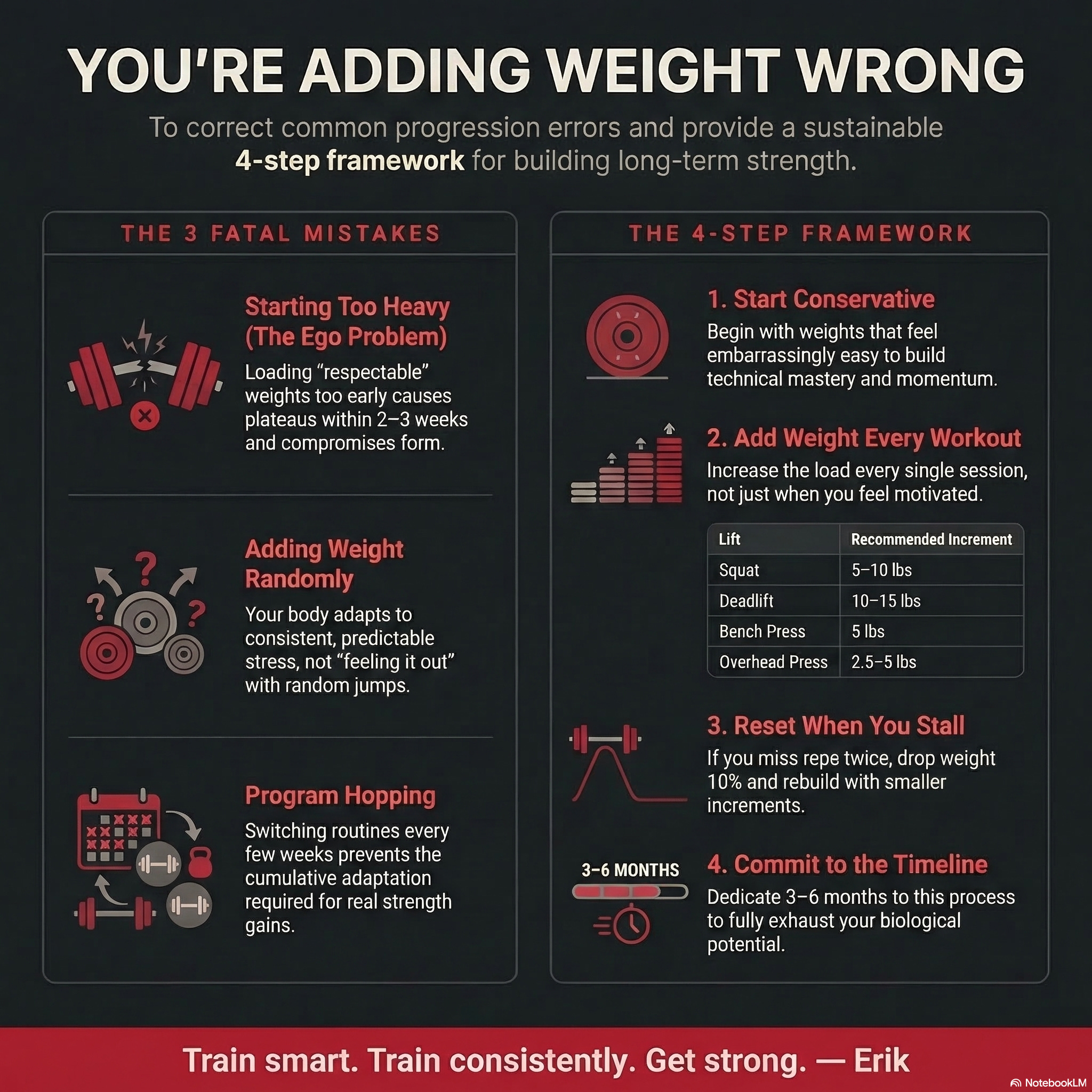
Mistake #1: Starting Too Heavy (The Ego Problem)
Walk into any gym on Monday and watch people squat. You’ll see lifters loading up 225, 275, even 315 pounds for their first working sets. They grind through 3-4 reps with questionable form, look satisfied, and move on.
What they just did: Massaged their ego.
What they didn’t do: Create a progression they can sustain.
Here’s what happens when you start too heavy:
You stall within 2-3 weeks
You learn terrible movement patterns under loads you can barely control
You kill your momentum before you’ve built any
The weight will get heavy fast enough. Starting with weights that feel embarrassingly easy serves two purposes:
You learn proper technique when the weights are still manageable
You build psychological momentum from weeks of consistent progress
Add 5 pounds to your squat every workout for 12 weeks starting at 135 pounds. That’s 60 pounds added, putting you at 195.
Start at 225 because it feels “respectable,” stall in three weeks, and you’ll still be at 225 three months later wondering why the program doesn’t work.
The fix: Start lighter than you think you should. If your ego protests, good—that means you’re doing it right.
Mistake #2: Adding Weight Randomly (The Consistency Problem)
Most people add weight like this:
Feel good today? Add 10 pounds
Feel tired? Keep the same weight
Feel great? Maybe add 20 pounds and see what happens
Stall? Try a completely different program
This isn’t progression. It’s chaos with a barbell.
Your body doesn’t adapt to randomness. It adapts to consistent, predictable stress applied progressively over time.
Progressive overload works because of cumulative adaptation. Each workout builds on the last one. Miss a step and you break the chain.
The math is simple: Add 5 pounds to your squat every workout for six months. That’s 130 pounds through consistent, boring progression.
Try adding weight whenever you “feel good” and you’ll be lucky to add 30 pounds in the same timeframe.
The fix: Pick your increments and stick to them. Every. Single. Workout.
For beginners:
Squat: 5-10 pounds per workout
Deadlift: 10-15 pounds per workout
Bench Press: 5 pounds per workout
Press: 2.5-5 pounds per workout
No variance. No “feeling it out.” Just consistent addition until it stops working.
Mistake #3: Program Hopping (The Commitment Problem)
You start a program. Three weeks in, progress slows slightly. You see a new program on Instagram that promises better results. You switch.
Repeat this cycle for a year and you’ll have tried twelve programs without mastering any of them.
Here’s what program-hoppers don’t understand: Every legitimate program works if you actually follow it long enough.
The problem isn’t the program. The problem is you’re not giving it time to work.
Linear progression doesn’t feel impressive week-to-week. Adding 5 pounds to your squat seems trivial. But that’s only because you’re measuring in days instead of months.
Six months of adding 5 pounds consistently? That’s transformative.
Six months of switching programs every time you get bored? That’s treading water.
The fix: Pick a program and commit for a minimum of 12 weeks. No exceptions. No “just trying” something new. Finish what you started.
The Framework That Actually Works
Stop overcomplicating this. Here’s what progression requires:
1. Start Conservative
Use weights that feel too light. I don’t care what you used to lift. I don’t care what your friend squats. Start with weights you can handle with perfect form for the prescribed reps.
If that means starting your squat at 95 pounds when you “know” you can squat 185, do it anyway. The weight catches up fast.
2. Add Weight Every Workout
Not every week. Not when you feel good. Every single workout.
Pick your increment. Add that weight. Don’t negotiate with yourself about whether you’re “ready.”
Your body is smarter than you think. If you’ve recovered from the last workout (and if you’re eating and sleeping adequately, you have), you can handle 5 more pounds.
3. Reset When You Stall
Eventually, you’ll miss reps. This is normal.
First miss: Try the same weight again next workout.
Second consecutive miss: Drop the weight 10%, then rebuild with smaller increments.
This isn’t failure—it’s the program working. You pushed to your current limit, backed off slightly, and you’re building back up with improved technique and capacity.
4. Commit to the Timeline
You need at least 3-6 months to exhaust linear progression if you’re a beginner.
Not 3-6 weeks. Months.
During this time, you should be adding weight almost every workout. If you’re not, you either started too heavy or you’re not recovering adequately.
What This Looks Like in Practice
Week 1: Squat 135×5×3 (feels easy, ego protests)
Week 4: Squat 180×5×3 (starting to feel real)
Week 8: Squat 225×5×3 (now it’s challenging)
Week 12: Squat 270×5×3 (strong, confident, zero missed workouts)
That’s 135 pounds added through simple, consistent application of basic principles.
Compare this to the lifter who started at 225 to feel strong, stalled at 245 by week 4, switched programs twice, and is still grinding the same weights three months later.
The Uncomfortable Truth
Proper progression isn’t exciting. It doesn’t make for dramatic Instagram posts. It won’t impress other people at the gym.
But it works.
The boring consistency of adding 5 pounds every workout builds more strength than the exciting chaos of random heavy days and program-hopping ever will.
Your choice is simple:
Trust the process and be dramatically stronger six months from now.
Or keep doing what you’re doing and wonder why you’re stuck at the same numbers a year from now.
Start Here
If you’re ready to stop spinning your wheels:
Pick your starting weights (lighter than you think)
Decide your increments (5-10 pounds for lower body, 2.5-5 pounds for upper)
Show up consistently (3x per week minimum)
Add weight every workout until you can’t
That’s it. No magic. No secrets. Just systematic application of progressive overload.
The question isn’t whether this works. The question is: will you actually do it?
What’s the biggest progression mistake you’ve made? Drop it in the comments—I guarantee you’re not alone.
Next time: The difference between training and exercise (and why it matters more than you think).
Train smart. Train consistently. Get strong.
—Erik