Write This Down
One simple habit that improves sleep, nutrition, stress management, and keeps you accountable.

Last post, I told you the three things that cause most stalls: sleep, nutrition, and stress.
Here’s the problem: Most people don’t actually know if they’re sleeping enough, eating enough, or managing stress well. They think they are. The data says otherwise.
Here’s the solution: A training log.
Not fancy. Not complicated. Just a notebook where you write down what you do every workout and track a few key metrics.
This one habit fixes everything.
What a Training Log Actually Does
A training log serves four purposes:
1. Proves you’re progressing You can see objectively whether you’re adding weight, not just “feeling” like you might be stronger.
2. Identifies patterns You’ll notice that every time you sleep poorly, your workout suffers. Or that weeks you eat more, you progress better.
3. Keeps you accountable Writing down that you’re about to squat 225 makes you more likely to actually attempt 225 instead of backing down to 205.
4. Provides data when troubleshooting When you stall, you can look back and see exactly what changed in the weeks before.
Without a training log, you’re training blind. You can’t tell if the program is working. You can’t identify what’s causing stalls. You’re just guessing.
What to Write Down (Every Workout)
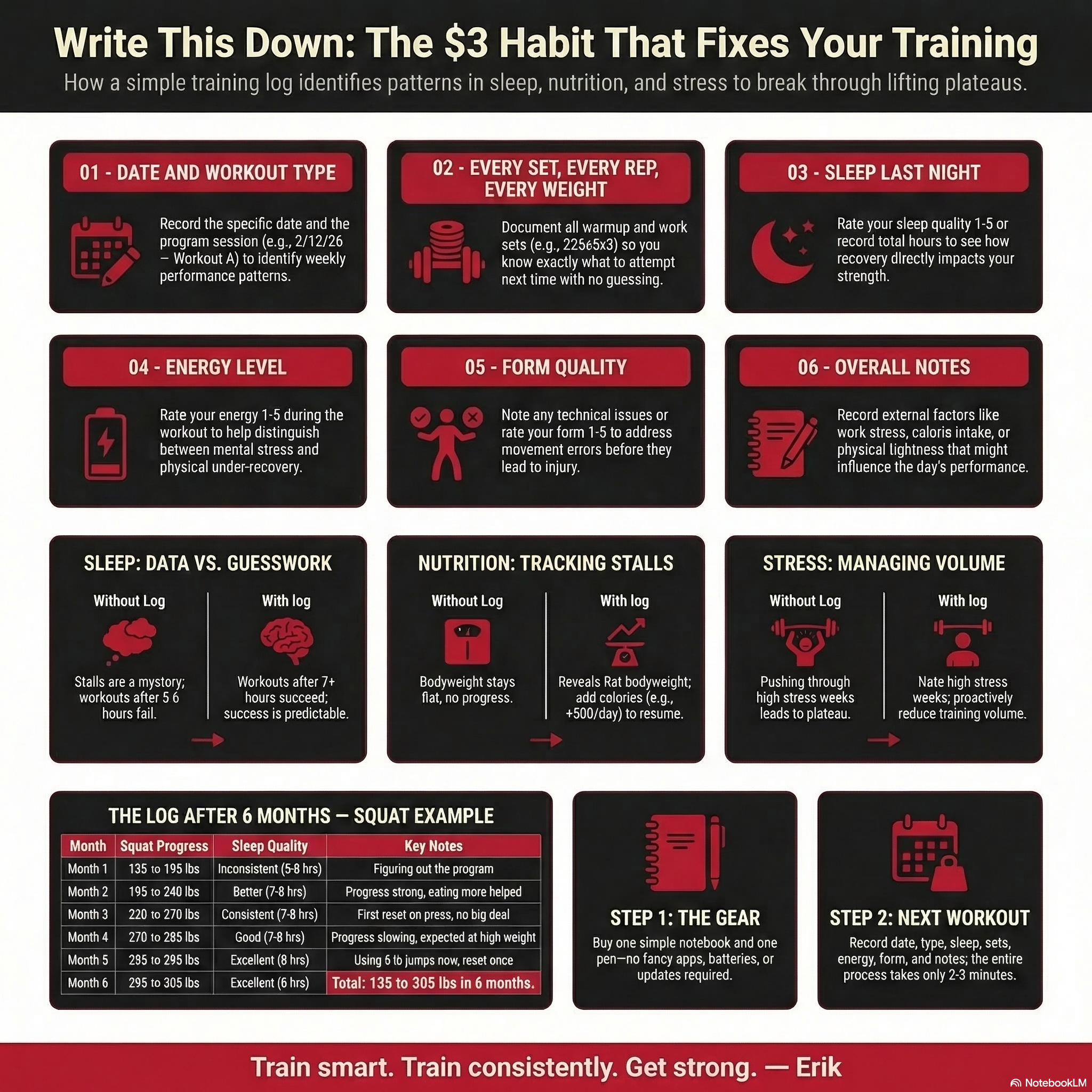
You don’t need an elaborate system. You need these six things:
1. Date and Workout Type
Example:
2/12/26 - Workout A
That’s it. Date and whether it’s Workout A or B (or whatever your program calls it).
Why this matters: You’ll see patterns like “I always struggle on Mondays” or “Wednesday workouts feel best.” These patterns inform scheduling decisions.
2. Every Set, Every Rep, Every Weight
For each exercise, write:
Warmup sets
Work sets
Weight used
Reps completed
Example squat entry:
Warmup: 45×5×2, 95×5, 135×3, 185×2, 205×1
Work sets: 225×5, 225×5, 225×4
Why this matters: You know exactly what to do next workout. No guessing. If you got 5, 5, 4 today, you attempt 225 again next time (not 230).
3. Sleep Quality (Last Night)
Rate 1-5 or just write hours slept.
Example:
Sleep: 7.5 hours (3/5 quality)
Why this matters: After tracking for two weeks, you’ll notice clear correlations. Poor sleep = poor performance. This makes sleep a priority, not optional.
4. Energy Level (During Workout)
Rate 1-5.
Example:
Energy: 4/5
Why this matters: Helps distinguish between “I felt tired but performed well” (stress, not recovery) versus “I felt tired and performed poorly” (inadequate recovery).
5. Form Quality
Rate 1-5 or just note major issues.
Example:
Form: 4/5 (depth good, slight forward lean on rep 4)
Why this matters: When weights get heavy, form degrades. Writing this down forces you to pay attention and address issues before they cause injury.
6. Overall Notes
Anything relevant to performance or recovery.
Example notes:
“Stressful week at work, deadline Friday”
“Ate extra 500 calories yesterday”
“Lower back tight, stretched 10 min before”
“Gym crowded, long wait for rack”
“PR today, felt strong”
Why this matters: When you stall or have an unusually good workout, you can look back and identify why.
The Complete Entry (Takes 2 Minutes)
Here’s what a full training log entry looks like:
Date: 2/12/26
Workout: A
Sleep: 7 hours (4/5 quality)
Energy: 4/5
Squat:
Warmup: 45×5×2, 95×5, 135×3, 185×2, 205×1
Work: 225×5, 225×5, 225×5
Form: 4/5 (good depth, maintained tightness)
Press:
Warmup: 45×5, 65×3
Work: 85×5, 85×5, 85×4
Form: 3/5 (bar drifted forward on last rep)
Deadlift:
Warmup: 135×5, 185×3
Work: 245×5
Form: 5/5 (perfect setup)
Accessories:
Barbell rows: 95×10×3
Dips: BW×12×3
Planks: 60sec×3
Notes: Good workout overall. Press felt heavy on last set—might need to check form next time or consider it was just an off day. Back to work stress this week but manageable.
Next workout plan: Squat 230, Press 85 (reload), Deadlift 260
Total time to write: 2-3 minutes after your workout.
How This Improves Sleep
You track sleep for two weeks. You notice a pattern:
Workouts after 7+ hours sleep:
Squat 225×5×3 ✓
Squat 230×5×3 ✓
Squat 235×5×3 ✓
Workouts after 5-6 hours sleep:
Squat 240×5,4,3 ✗
Squat 240×5,5,4 ✗
The data is undeniable. When you sleep less than 7 hours, you can’t complete your sets.
This makes sleep non-negotiable. You’ll prioritize it because you’ve seen the direct correlation in your own training log.
Without the log, you might think “I don’t know why I stalled at 240.” With the log, it’s obvious: you’re not sleeping enough.
How This Improves Nutrition
You track bodyweight weekly in your log.
Week 1: 180 lbs, added 15 lbs across lifts Week 2: 180 lbs, added 15 lbs across lifts Week 3: 180 lbs, added 10 lbs across lifts Week 4: 180 lbs, stalled on squat
Pattern: You’re not gaining weight. Progress is slowing.
You note in your log: “Track calories for 3 days”
Result: You’re eating 2,400 calories per day. Target is 2,900-3,200.
Fix: Add 500 calories per day. Start gaining 1-2 lbs per month. Progress resumes.
Without the log: “I eat a lot, I don’t know why I’m not progressing.”
With the log: “I’m not gaining weight despite progressive training. I need to eat more.”
How This Reduces Stress
You track stress levels in your notes section.
Weeks 1-4: “Normal work stress, relationship good”
Progress: Added 60 lbs to squat
Week 5: “Major project due, working late every day”
Progress: Stalled on all lifts
Week 6: “Project over, back to normal”
Progress: Resumed (after 10% reduction)
The log shows you: High stress weeks kill progress, even with good sleep and nutrition.
This informs decisions: When stress is high, you proactively reduce training volume instead of pushing through and stalling.
You learn to adjust training based on life stress because your log proves the correlation.
The Weekly Review (5 Minutes)
Every Sunday (or whatever day), review your training week.
Look at:
Progress made:
Added 15 lbs to squat
Added 5 lbs to bench
Maintained press
Sleep average:
4 days at 7+ hours
2 days at 6 hours
1 day at 5 hours
Average energy:
3.8/5 (slightly below normal)
Bodyweight change:
Started week at 180, ended at 181 (+1 lb)
Pattern recognition:
Energy was low on days following poor sleep
Best workout was Wednesday (8 hours sleep + 4,000 calorie day before)
Adjustments needed:
Prioritize sleep more consistently
Consider slightly higher calorie intake
The Monthly Summary (10 Minutes)
End of month, look at the big picture.
Month: January 2026
Starting weights:
Squat: 135
Bench: 95
Press: 65
Deadlift: 135
Ending weights:
Squat: 195 (+60 lbs)
Bench: 120 (+25 lbs)
Press: 80 (+15 lbs)
Deadlift: 215 (+80 lbs)
Total weight added: 180 lbs across all lifts
Bodyweight: 178 → 182 (+4 lbs)
Workouts completed: 12 of 12 (100% adherence)
Sleep average: 7.2 hours
Key learnings:
Linear progression working perfectly
Best progress weeks followed 8+ hour sleep nights
Press stalled once, reload worked immediately
Need fractional plates for press (adding 5 lbs getting difficult)
Goals for next month:
Maintain 8+ hours sleep minimum 5 days/week
Continue current progression
Order fractional plates this week
What This Looks Like After 6 Months
You flip back through your training log.
Month 1:
Squat: 135 → 195 (+60 lbs)
Sleep: Inconsistent (5-8 hours)
Notes: “Figuring out the program”
Month 2:
Squat: 195 → 240 (+45 lbs)
Sleep: Better (7-8 hours most days)
Notes: “Progress strong, eating more helped”
Month 3:
Squat: 240 → 270 (+30 lbs)
Sleep: Consistent (7-8 hours)
Notes: “First reset on press, no big deal”
Month 4:
Squat: 270 → 285 (+15 lbs)
Sleep: Good (7-8 hours)
Notes: “Progress slowing, expected for higher weights”
Month 5:
Squat: 285 → 295 (+10 lbs)
Sleep: Excellent (8 hours consistent)
Notes: “Using 5 lb jumps now, reset once”
Month 6:
Squat: 295 → 305 (+10 lbs)
Sleep: Excellent (8 hours)
Notes: “Approaching intermediate programming transition”
Total progress: 135 → 305 lbs (+170 lbs in 6 months)
You can see:
Exactly when you prioritized sleep (Month 2)
When progress naturally slowed (Month 4-6)
That you completed 70+ workouts consistently
Every reset, every stall, every breakthrough
This data is invaluable. You know what works. You know what doesn’t. You have proof.
What You Don’t Need
You don’t need:
Fancy apps (though they’re fine if you prefer them)
Elaborate spreadsheets
Detailed macronutrient tracking
Heart rate monitors
Complicated formulas
You need:
A notebook
A pen
2-3 minutes after each workout
5 minutes once per week
10 minutes once per month
That’s it.
The Psychological Benefit
There’s something powerful about writing down weights before you lift them.
In your log, you write: “Squat: 235×5×3”
This creates commitment. You wrote it down. Now you have to attempt it.
Compare this to: “I think I’ll try 235 today... or maybe 225 feels better... actually let’s just do 215 and see how it feels.”
Writing it down eliminates negotiation. The plan is the plan.
This applies to recovery too:
You write: “Sleep goal: 8 hours tonight”
Then you see it written down. You’re more likely to actually go to bed on time because you committed to it in writing.
Accountability to yourself is powerful.
Common Objections
“I’ll remember what I lifted”
No, you won’t. Not accurately. Not three workouts ago. Definitely not three months ago.
“I use an app”
Great. As long as you’re tracking. Most people download an app, use it twice, and quit. A notebook doesn’t require batteries or updates.
“I don’t have time”
You have time to train for 45-60 minutes but not 2 minutes to write down what you did? That’s a priority problem, not a time problem.
“It seems tedious”
So does training. So does eating right. So does sleeping 8 hours. All the things that work seem tedious until they become habits.
How to Start Today
Buy:
One notebook (any notebook, doesn’t matter)
One pen
Next workout:
Bring notebook to gym
Write down date, workout type, sleep from last night
Write down every set: warmup and work sets
Rate energy and form
Add any relevant notes
Write down next workout’s plan
That’s it.
The Bottom Line
A training log costs $3 and takes 2 minutes per workout.
It will:
Prove you’re progressing (or not)
Show you sleep directly affects performance
Demonstrate that eating more helps
Reveal that stress kills progress
Keep you accountable to your plan
Provide data when troubleshooting
Give you a record of your entire journey
Most people who stall can trace it back to poor sleep, inadequate nutrition, or high stress.
Most people who stall have no data to prove which one is the problem.
A training log gives you that data.
Write down your sleep. You’ll sleep better because you see the correlation.
Write down your bodyweight weekly. You’ll eat better because you see when you’re not gaining.
Write down stress levels. You’ll manage it better because you see when it impacts training.
One simple habit. Fixes three problems.
Do you currently keep a training log? If not, what’s actually stopping you? Drop it in the comments.
Train smart. Train consistently. Get strong.
—Erik